Talent, Leadership and Learning
A Learning Function Under Pressure: How to Design an Effective Learning Strategy
Learning is a core business capability. Organisations survive and grow by solving problems, adapting to new conditions and developing the capabilities required to execute their strategy. When organisations fail to learn fast enough, or fail to develop the capabilities that matter most, performance suffers.
Yet in many organisations the learning function remains under-powered, pulled into order-taking and struggling to demonstrate impact. Learning is still often treated as something that happens away from work, through courses and programmes, measured by activity and completion rather than through changes in capability or performance.
This disconnect is becoming more visible in the Gulf region, where national transformation agendas are placing increasing emphasis on productivity, skills development and human capability. Organisations increasingly need to develop talent from within.
However, many organisations still struggle to translate learning investment into measurable business outcomes. Only 10% of respondents to a global CRF survey said learning was clearly linked to performance, productivity or innovation outcomes, and that this connection was visible to senior leaders. At the same time, the pace of change is accelerating. Automation and AI are reshaping work, increasing demand for new skills and adding pressure to build capability at greater scale and speed.
The organisations seeing the greatest impact are not those simply investing in more learning tools, but those focusing on how learning connects with strategy, work and talent processes.
Against this backdrop, CRF’s Effective Learning Ecosystem model helps create a clear line of sight from strategy to performance, showing how all aspects of the people experience can join up to deliver effective business outcomes through learning.

Gulf Conference: Creating An Effective Learning Ecosystem
Our full research, including the model, will be launched at our upcoming Conference in Abu Dhabi on 7 May.
Register now to secure your place to join over 100 senior HR leaders to hear from experts from ACWA Power, ADNOC, Harvard Business Impact, Saudi Aramco and more.
.
CRF’s Effective Learning Ecosystem Model
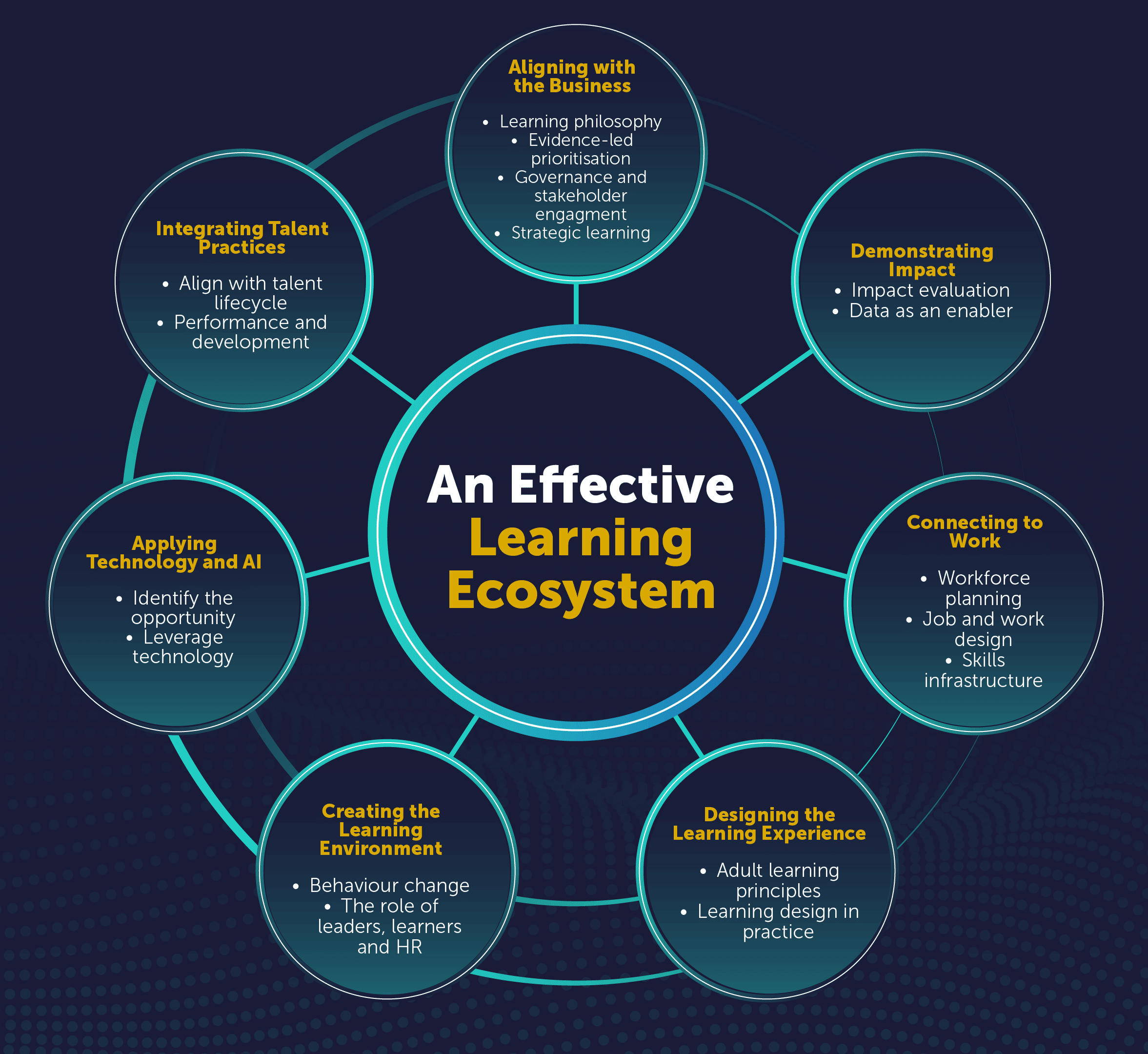
This model supports organisations to move beyond “courses and content” by bringing together seven building blocks that need to work together:
- Aligning with the business. Focus on a smaller number of critical capabilities and start with strategy rather than training requests. Do you have a deep understanding of where value is created in the business and where performance is breaking down?
- Demonstrating impact. Define success clearly, establish a baseline and use evidence that leaders care about. Can you show how learning influences performance, not just participation?
- Connecting learning to work. This requires a granular understanding of how work is performed in practice and how it is evolving. How is your learning approach informed by Strategic Workforce Planning, job design and – where appropriate – a skills lens?
- Designing the learning experience. Applying what we know about how adults learn. Are you selecting the most relevant learning type, or just defaulting to large-scale development programmes?
- Creating the learning environment. Making sure the work environment supports application and reinforcement. What specific behaviours need to change, and are leaders and managers reinforcing them?
- Applying technology and AI. Starting with purpose and what we know about how adults learn best rather than tools. Is AI helping you redesign learning around performance, or just produce more content faster?
- Integrating talent practices. Learning must integrate with the broader HR system, particularly the talent lifecycle. How does learning align with career performance, succession and reward?
The future of learning depends less on new tools and more on the professional evolution of L&D itself. Learning functions need to move beyond content production and programme management. Instead, they need capabilities that allow them to connect business priorities, work design and learning interventions in a coherent way.