AI and Technology
Summary Notes and Webinar Recording: Where Does AI Really Create Value?
On 17 September 2026, Prof. Rob Briner, Associate Research Director at CRF, and Johannes Sundlo, Founder of Prorio AI, launched CRF’s AI in HR Series with its opening webinar, Where Does AI Really Create Value?
AI is already changing how work gets done, and the pressure to act is intensifying. New tools arrive almost daily, and the temptation is to move quickly simply to avoid falling behind. But speed is not progress. Organisations must determine where AI will improve something that matters, where it may create new risks and where human judgement must remain central.
HR has a decisive role to play. It does not need to become the technology expert, but it must help the business make better choices about how work should change, what people will need to succeed and where AI genuinely belongs. Through events, practical learning and research, CRF’s AI in HR Series will help HR turn experimentation into business value.
Seven principles for making better decisions about AI
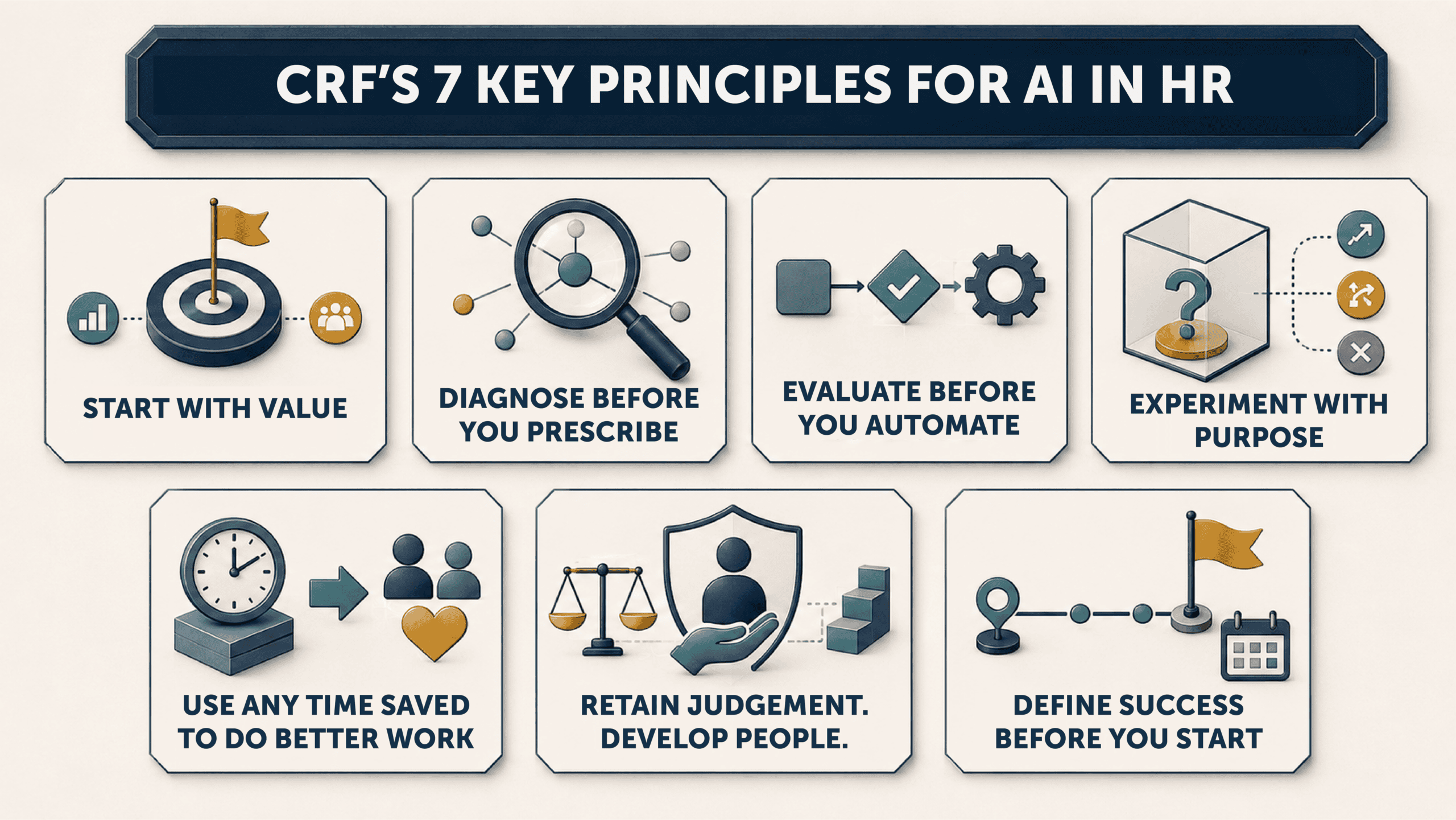
The webinar centred on CRF’s recently published Seven Key Principles for AI in HR. Designed to cut through the hype and urgency surrounding AI, they replace the question “How can we use it?” with a more demanding one: “Where will it create value?”
These are not instructions for choosing tools. They provide a practical framework for deciding when, where, why and how AI should be used. They help organisations avoid automating work that should be redesigned, treating time saved as value and allowing human capability to weaken in pursuit of efficiency.
Explore CRF’s Seven Key Principles for AI in HR to understand the thinking behind each principle and consider the practical questions that can help your team put them into action.
Five key takeaways
The discussion made one point unmistakably clear: adopting more AI will not automatically create more value. These five lessons can help HR make choices that improve work rather than simply accelerate it.
1. Value begins with the outcome, not the technology
Too many AI initiatives begin with a tool in search of a problem. The better starting point is the outcome the organisation needs to improve and the barriers currently standing in its way.
Consider onboarding. Is the aim to help new employees contribute sooner, improve their experience or increase retention? Each is a different problem and may require a different response. Until the intended outcome is clear, an organisation cannot know whether AI is the right intervention or judge whether it has worked.
2. Sometimes the fastest route to value is to slow down
AI can make a process faster without making it any better. Before automating something, organisations should ask whether the process is necessary, whether it works and whether it contributes to an outcome that matters. A poor process should be removed or redesigned, not accelerated.
Experimentation also needs discipline. Testing AI can build familiarity, but useful experiments begin with a clear question and a defined measure of success. What works can be scaled. What shows promise can be adapted. What adds no value should be stopped.
3. Individual productivity does not guarantee organisational performance
AI may help someone finish a task more quickly. That does not mean their team or function will perform better. Work is interconnected. Changing one task can move work elsewhere, create new demands for colleagues or disrupt the way roles fit together.
A Swedish public body tackled this challenge by bringing senior leaders and employees together for five AI learning sessions over three months. Rather than imposing a strategy from above, leaders built a shared understanding of where AI supported the organisation’s purpose and where it did not. One application that followed used AI to triage incoming claims, significantly reducing response times.
4. Time saved is a resource, not a result
A shorter task is not, by itself, a better business outcome. Value depends on what happens to the capacity AI releases.
One organisation automated much of the administration involved in supporting employees working on visas. It then moved two employees from processing paperwork to providing visa holders with more personal support. Engagement among this group increased. The value did not come from saving time alone, but from consciously reinvesting it in work that mattered more.
This is a choice organisations must make in advance. Otherwise, promised efficiencies may never translate into better performance.
5. More AI makes human judgement more valuable
AI can produce polished and convincing work at speed. That does not make the output reliable, appropriate or correct. As adoption grows, employees will need to question what AI produces, spot errors and know when to accept, revise or reject its conclusions.
Managers must set clear expectations for the quality and accountability of AI-assisted work.
Judgement also means noticing what efficiency removes. One geographically dispersed organisation introduced a chatbot that answered routine HR questions effectively. It later withdrew it. As employees stopped contacting HR, the function lost the informal “while I have you” conversations through which concerns surfaced and relationships were maintained.
The chatbot worked. The problem was that its efficiency came at the cost of connection.
Q&A Corner
Attendees submitted a wide range of questions during the webinar. Here, Johannes Sundlo responds to those that could not be fully addressed during the session.
1. How should organisations balance using a pre-built AI system with developing their own approach through a platform such as Microsoft Copilot?
My advice to start with Copilot assumes that you are already a Microsoft customer. Otherwise, it would not be my starting point. I personally prefer ChatGPT and Claude for much of my work and think the additional effort required to integrate them and introduce appropriate security controls can be worthwhile.
I also suspect that access to useful AI tools will become an employer-branding question: which tools will people expect an employer to allow them to use?
2. Are organisations adopting AI before defining the use case or understanding the problem?
I often see organisations rush into this, selecting a process without first asking whether it works well or what the potential gain would be.
There is a chicken-and-egg problem, however. You need some understanding of what AI can do today to identify worthwhile opportunities. Practical exploration and critical assessment of the process therefore need to happen together.
3. How can organisations maintain effort, learning and skill as AI use grows?
The honest answer is that we do not yet know how AI will affect learning and expertise over time. But we should also ask which knowledge we are trying to preserve and why.
A modern farmer might struggle if dropped into 1926 without today’s tools. That would not make them a worse farmer today; their expertise has developed around different tools and conditions. How much of what we call ‘skill erosion’ is a similar change in what people need to know?
The same question applies to verification. If AI becomes demonstrably more reliable at particular tasks, how much human checking will those tasks still need? That is not a reason to stop checking today, but we should not define future human work entirely around today’s technological limitations.
Which capabilities would we regret losing and which could we let go as our tools improve? I do not have a settled answer or a concrete organisational example that I would confidently present as the solution.
4. Should organisations proceed cautiously now and accelerate once the AI market has settled?
If we wait for things to settle, we could be waiting a very long time. Parts of the AI investment market may prove to be a bubble, but I do not think that makes the underlying technology one.
Each organisation must make its own decisions. My view is that waiting for a stable landscape before learning anything would be a poor bet.
5. How effective are AI-enabled nudges in improving management or leadership capability?
BetterUp is one example I have encountered, but I have not seen enough research to claim confidently that AI nudges improve leadership capability.
My own example is narrower. I built a payroll reminder agent and on-time reporting rose from an average of 82% before its introduction to 97% over the following three months. That is an encouraging practical result, although it does not establish the agent as the sole cause or show that nudges make someone a better manager.
6. How should financial considerations feature in decisions about AI?
I would treat AI like any other investment: the organisation should be clear about what it expects in return and how that return will be assessed.
Learning can be a valid return from an experiment, but ‘we’re testing’ still requires a defined question, budget, timeframe and decision about what happens afterwards.
7. What is your most successful personal use of AI?
Narrowing this down is difficult. My favourite is a family-planning agent built around our household. Every Saturday, it gathers information from the children’s school portal and updates our shared schedule, both in an app and in a version we print for the fridge.
It also helps us plan meals and recipes, lets us check what we have at home by voice and prepares the grocery order for us to approve and pay for. It is highly specific to our family, which is exactly why it is useful. I built it entirely through ‘vibe coding’ in Codex.
The other is an expense agent that helps me keep track of costs and receipts. Neither is particularly glamorous, but both take care of tasks that would otherwise keep demanding my attention.
8. Could Claude meet most of an organisation’s AI needs?
Yes. I think Claude can meet a substantial share of an organisation’s needs. I use it extensively.
I would explore how far it can take you in your work before assuming that every use case requires a separate specialist tool.
CRF’s AI in HR Series
Knowing that AI can do something is easy. Deciding whether it should, what outcome it needs to improve and how success will be measured is much harder.
CRF’s first on-demand course, Understanding Where Value Is Created, gives HR practical tools for making those decisions. It will help you identify worthwhile opportunities for AI, diagnose the problem before selecting a solution and focus investment where it can deliver meaningful organisational value.
Start Course 1 immediately or enrol in the complete four-course AI in HR bundle. You will receive each new course as it launches, covering individual productivity and judgement, line-manager effectiveness and the redesign of work and capability. The bundle saves up to £296 compared with purchasing the courses separately.
For further information, contact rosanna@crforum.co.uk.